
Every city's plumbing ages, but not at the same speed, and the difference is mostly dissolved rock. Compton runs its own municipal water system, pumping roughly 80 percent of its supply from 8 city-owned wells in the Central Basin aquifer, with the balance imported through 3 Metropolitan Water District connections. The city's water quality reporting describes that supply as moderately hard to very hard, between 6.5 and 15 grains per gallon depending on source and season, and some independent analyses have measured local samples higher still. That water is safe to drink, meets every standard, and has quietly been sandblasting the inside of the city's copper pipes for sixty years. This post explains how, because homeowners who understand the mechanism make better decisions than homeowners who just fear it.
What "hard" actually means
Hardness is dissolved calcium and magnesium, measured in grains per gallon or parts per million. The Central Basin's groundwater picks its minerals up honestly: the aquifer sits in sediments laid down by ancient seas and rivers, and water percolating through that material for centuries arrives at the wellhead carrying the geology with it. For scale, water professionals class anything above about 10.5 grains per gallon as very hard; Compton's own reporting spans from moderately hard into that territory, and regional surveys of Southern California supplies routinely find some of the hardest municipal water in the country here.
| Hardness class | Grains per gallon | Where Compton sits |
|---|---|---|
| Soft | under 1 | 6.5 to 15 GPG per city reporting, moderately hard to very hard, varying by well and season |
| Moderately hard | 3.5 to 7 | |
| Hard | 7 to 10.5 | |
| Very hard | over 10.5 |
Two ways minerals kill a pipe
Scale is the visible mechanism. Heated or slowed water drops its minerals as deposits: the white crust on your shower head, the sediment blanket in your water heater, the ring inside a kettle. Scale insulates heating elements, chokes aerators and valves, and shortens appliance life, but it rarely breaches a pipe by itself.
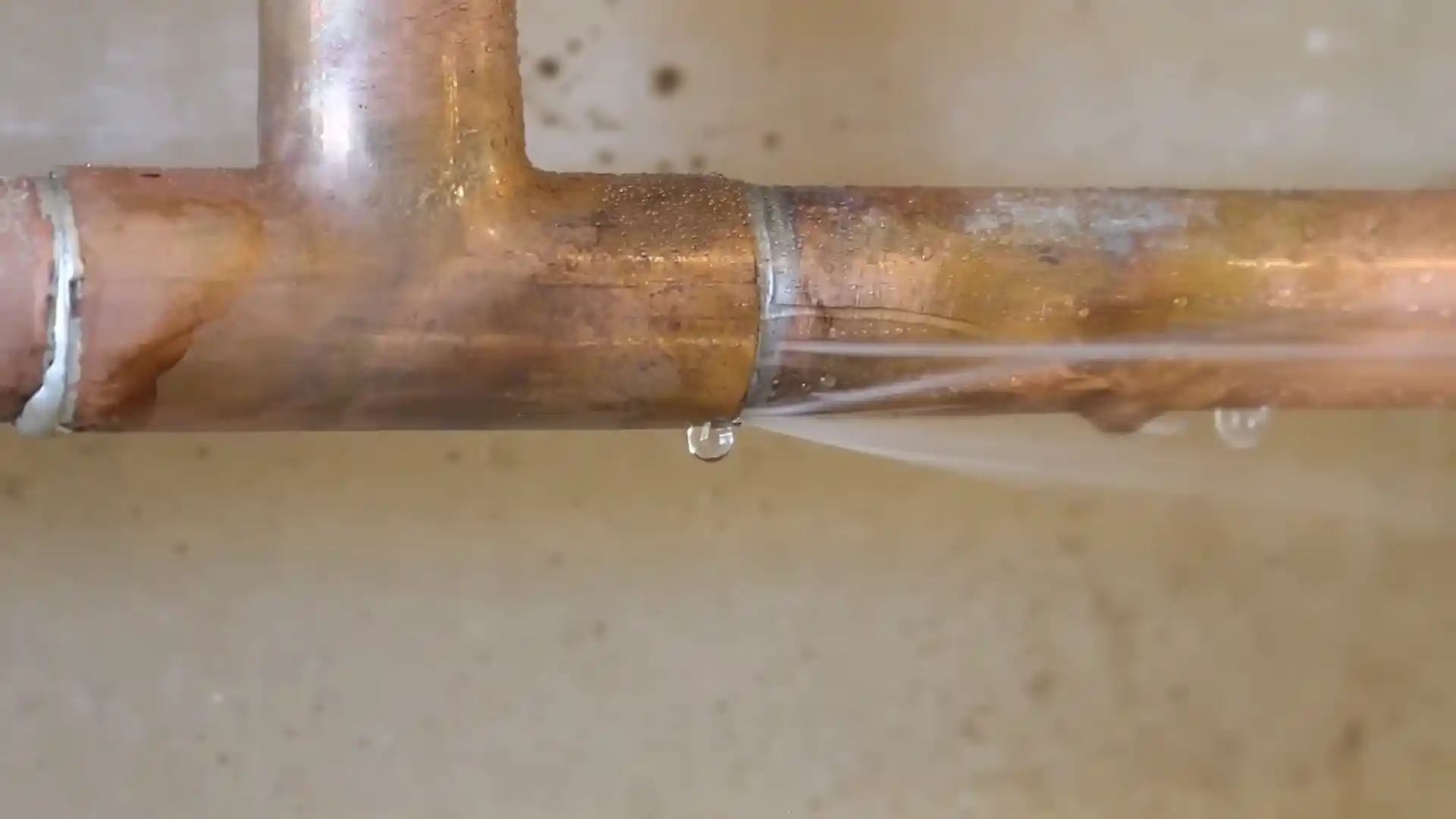
Pitting corrosion is the killer. Inside aging copper, the chemistry of mineral-rich water, its dissolved solids, its alternating chlorine and chloramine disinfection as well water blends with imported supply, attacks the pipe wall at microscopic weak points. Instead of thinning evenly, the metal develops tiny deepening craters. A pit that started in the 1990s breaks through in the 2020s as a pinhole: a leak the width of a needle, misting silently into a wall or slab. And because pitting is a whole-system process, the first pinhole is rarely alone; its siblings are maturing elsewhere along the same runs.
Green crust showing at your fittings?That is the chemistry surfacing. An inspection grades what remains.
✆ (424) 544-0235Why the timeline lands exactly now
Compton's great residential buildout ran from the late 1940s through the 1960s, plumbed almost universally in the rigid copper of the day, much of it the thinner-wall type the era considered adequate. Copper's practical service life in aggressive water runs several decades, which means the math is not subtle: pipe installed in 1955, carrying this mineral load since, crossed into its statistical failure window years ago. That is why the pinhole calls cluster so tightly in the tract neighborhoods, why streets in areas like Rosewood report failures in waves rather than at random, and why a first leak in a tract home is best read as information about the system rather than bad luck at one joint. The full failure pattern, and how detection finds these misting leaks before drywall does, lives on our pinhole detection page.
Can anything slow it down?
Honestly: somewhat, with caveats. Traditional salt-based softening removes the hardness minerals, and Southern California forums are full of homeowners crediting softeners with saving their water heaters. But California restricts salt-discharging softeners in many areas over brine pollution concerns, with a number of communities banning them outright, so the local conversation increasingly involves alternatives: template-assisted crystallization conditioners, whole-house filtration, and pressure management. Two truths frame all of them. Treatment can slow future damage but cannot restore metal already lost to pitting; copper that is failing needs repair or replacement first, treatment second. And unmanaged water pressure multiplies every weakness the minerals created, which is why a healthy pressure regulator is the least glamorous and most cost-effective protection old copper can have.
What this means for your house, practically
If your home predates 1970 and still runs original copper, assume the chemistry has been working and let evidence tell you how far it got. Green-blue crust at fittings, a pinhole history on your street, fading pressure, or a first leak of your own are all data points on the same curve. The reasonable response is not panic and not denial; it is an assessment: a pressure reading, an inspection of exposed runs, and a straight answer about whether your system is sound, tired, or due. The water is not going to change. Your information about your pipes can, this week, for the cost of a service call.
The longer view
There is something almost geological about the whole story: an ancient seabed dissolving, molecule by molecule, into the water that built a postwar city, and now collecting its toll from the pipes that carried it. Nobody did anything wrong. The city delivers the water its basin holds; the builders used the best material of their day; the chemistry simply never stopped. Understanding that removes the mystery from the pinholes and replaces it with a schedule, and schedules, unlike mysteries, can be planned for.
Reading your own water report
Every July, the city publishes a Consumer Confidence Report, the annual water quality document every utility must issue, and it is worth ten minutes of any homeowner's attention. Find the hardness line, usually expressed in parts per million or grains per gallon, and note the range rather than the single number, because supply here blends well water with imported deliveries in proportions that shift by season and by year. The report also lists total dissolved solids, chloride, and the disinfectant in use, each a supporting character in the corrosion story. None of it requires a chemistry degree: you are looking for where your neighborhood's supply sits on the hardness table above, and whether the trend across a few years' reports runs stable or upward.
For house-level truth, a simple test tells you what actually arrives at your tap. Hardware-store test strips read hardness in seconds and cost little; a mail-in laboratory panel adds precision and the corrosion-relevant extras. Test at an outdoor bib for the raw supply and, if you run any treatment equipment, at an indoor tap to verify the equipment is earning its keep. Homeowners with softeners or conditioners should test annually; a treatment system that quietly stopped working protects nothing while charging for salt.
What you do with the numbers is triage. Hardness in the moderate range with young plumbing means the ordinary maintenance rhythm: annual water heater flushes, aerators cleaned, pressure checked. Hardness at the very hard end over tract-era copper means the accelerated rhythm this post describes, plus a lower threshold for investigating any symptom. And any test showing a dramatic change from the city's published range is worth a call to the utility before it is worth a call to a plumber, because a sudden shift usually means a source change or a testing error rather than a plumbing event. The report is free, the strips are cheap, and together they convert this whole article from general science into your address's specific forecast.
Calling from Long Beach instead of Compton?
Everything above applies the same way north of the city line — the diagnostic steps, the pricing model, and the same dispatch. The one thing that can differ is water source: Long Beach blends imported and local groundwater through Long Beach Water Department rather than Compton's own well system, so mineral content can vary by block. See our Long Beach service area page for coverage details, or just call — the technician on your job will confirm specifics for your address either way.
Find out where your copper is on the curve
A pressure test plus an inspection of exposed runs tells you honestly whether your system is sound, tired, or due. Evidence first, always.
✆ Call (424) 544-0235