
The water arriving at your property line does not carry house-friendly pressure. Municipal mains run high by design, commonly 80 to well over 100 psi in parts of the distribution grid, so the far ends of the system still get served. Residential fixtures, appliances, and code all expect something gentler, and the single component tasked with the conversion is the pressure regulating valve: a spring-loaded brass fitting near your main shutoff that throttles street pressure down to a set point, usually 50 to 60 psi, every second of every day. It is the hardest-working part in the system and the least examined. When it drifts high, sticks, or dies, nothing announces it. The house just starts failing in small ways, everywhere at once.
The symptoms of a regulator going bad
A failing PRV writes its signature across the whole house. Faucets that blast and splash. Water hammer, the bang in the walls when a valve snaps shut, as excess pressure slams to a stop. Toilets that hiss and refill at random as their fill valves lose the fight. A relief valve weeping at the water heater, which is the tank's own gauge telling you pressure or thermal expansion has gone wrong. Serial fixture failures, three faucet cartridges in a season. And on the leak side, the pattern we care most about: pinholes and joint failures arriving faster than a system's age alone explains, because every psi over spec multiplies stress on every worn spot the decades have thinned.
Testing takes five minutes and a gauge
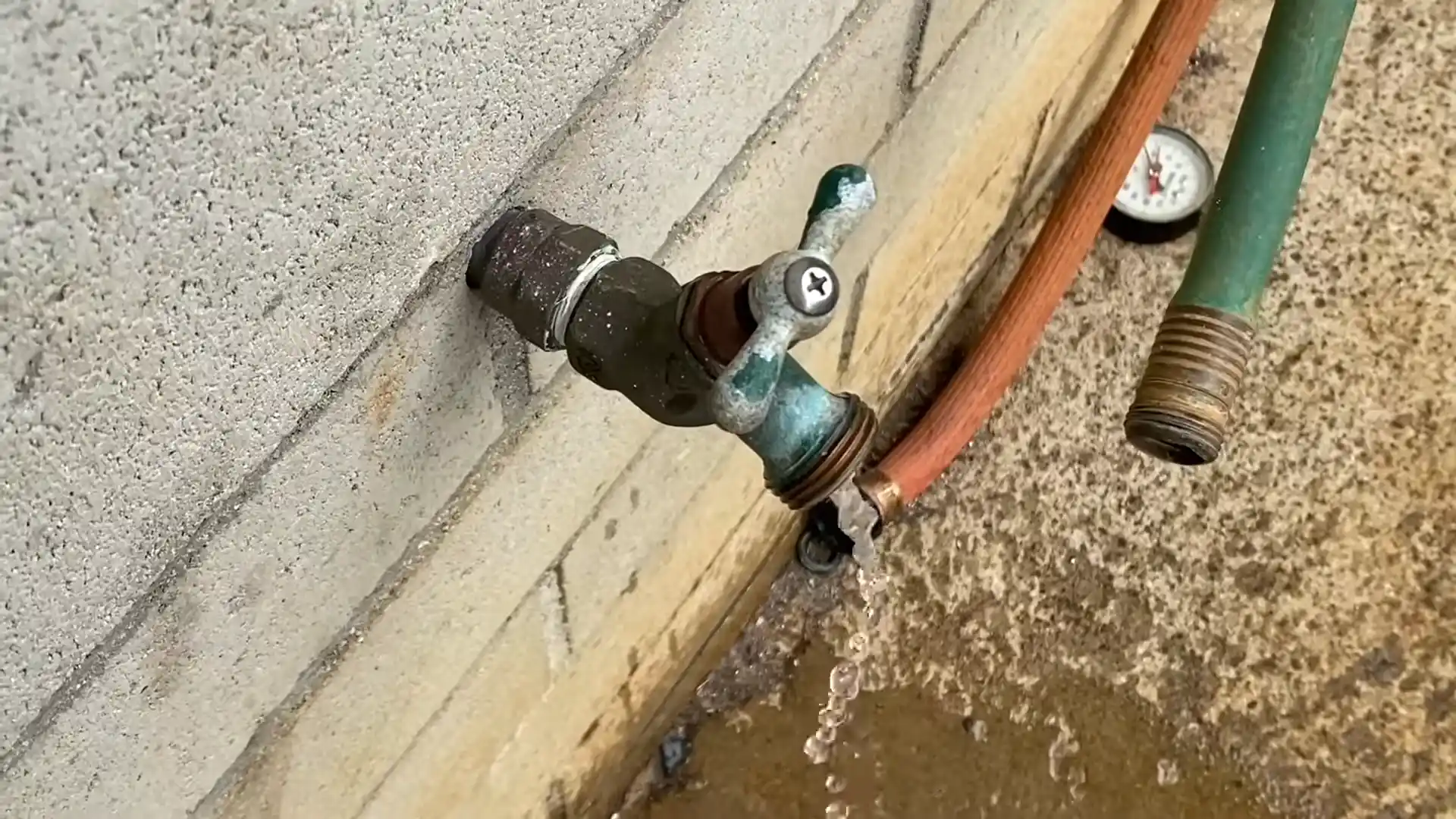
Diagnosis is refreshingly concrete. A gauge threads onto an outdoor hose bib and reads static pressure directly; a second reading overnight or with a lazy-hand gauge catches the spikes thermal expansion and municipal cycling produce. Healthy: a steady number in the 50s. Suspicious: 75 and climbing, or readings that swing widely between draws. Condemning: 90-plus, or a regulator that no longer responds to its adjustment screw. We also confirm the regulator actually exists, because a surprising number of older Compton homes either never had one or buried it behind decades of remodeling, running street pressure raw their whole lives.
Replacement, set point, and the expansion question
Regulators are wear items with a service life of roughly a decade in this water, whose mineral load scales their internals like everything else it touches. Replacement is a same-day job at the service entry: new valve, set to spec with a gauge, unions installed so the next change takes minutes. Where the house has a closed system, a check valve or the new regulator itself blocking backflow, we add or verify a thermal expansion tank, because heated water needs somewhere to push and the relief valve should not be its daily outlet. Set point gets tuned to the house: enough for strong second-story showers, no more than the fixtures were built to hold.
Why this one part earns its own page
Because it is upstream of everything. We meet homes in Compton, and just east in Bellflower's similar stock, where years of fixture repairs, mystery drips, and even a pinhole streak all traced back to a regulator that quietly failed at year twelve and let 95 psi loose on plumbing rated for 60. Every one of those repairs was real, and every one was treating symptoms. The gauge test is minutes and the fix is an afternoon. If your house is showing the pattern, start upstream: (424) 544-0235.
Gauges are cheap, and we would rather you own one. Thread it on a hose bib twice a year, note the number, and you hold the earliest warning system plumbing offers. A reading that climbs year over year is a regulator asking politely before it stops asking.
Banging pipes, blasting faucets, or serial fixture failures?Dispatch answers 24/7. Written quote before any work.
✆ (424) 544-0235PRV questions from Compton homes
What pressure should my house actually run?
Between 50 and 60 psi suits most homes: strong showers, gentle on seals. Code treats 80 as the ceiling requiring regulation. If a gauge shows you above that, the regulator conversation is already overdue.
Where is my pressure regulator?
Usually a bell-shaped brass fitting near the main shutoff, at the front hose bib riser, in the garage, or where the service line enters. Some older homes here have none at all, which the gauge reveals immediately.
Can a bad PRV cause low pressure instead of high?
Yes. Failing regulators die both directions: springs weaken and choke flow, or debris jams them partly closed. A house that faded from strong to weak over months often has a clogged regulator, not clogged pipes.
Is water hammer just an annoyance?
It is a symptom with consequences. Each bang is a shockwave slamming joints and valves, and over years it works connections loose. Fixing the pressure, and arrestors where needed, protects the system, not just the silence.