
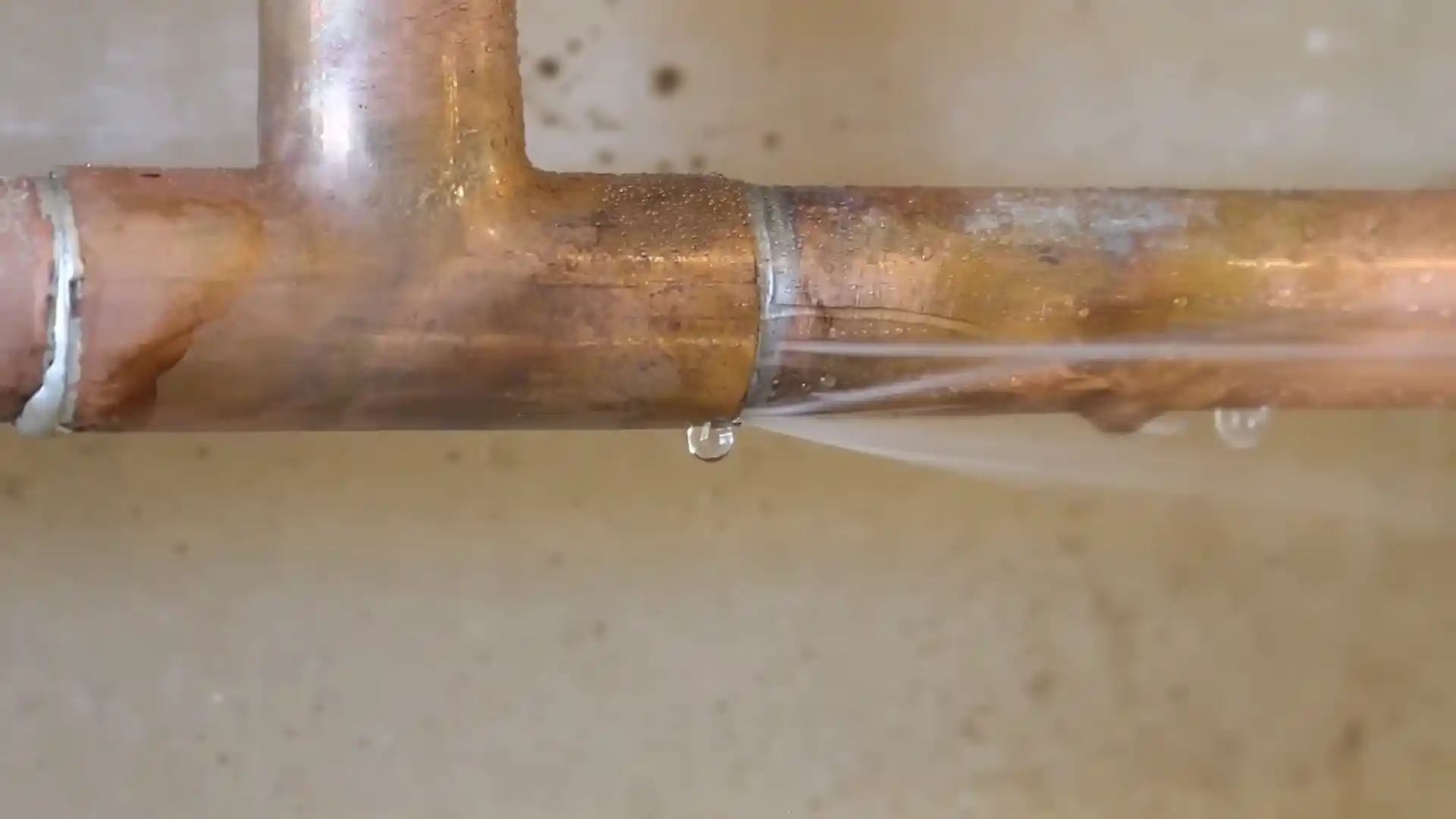
Between the late 1940s and the end of the 1960s, builders filled Compton's remaining farmland with tract housing at a pace the city has never matched since, and nearly every one of those homes was plumbed in copper. It was the premium material of its day, rated in theory for half a century or more. The theory did not anticipate what would flow through it: decade after decade of the city's own Central Basin well water, carrying one of the heaviest mineral loads of any municipal supply in California. That copper is now 60 to 80 years old, and across neighborhoods like Sunny Cove, Rosewood, and the postwar grids east and west of Alameda, it is failing on schedule.
How hard water kills copper from the inside
Two mechanisms do the damage. Pitting corrosion attacks the pipe wall at microscopic weak points, drilling craters that deepen for years until one breaks through as a leak the width of a needle. Erosion-corrosion works at the turns, where decades of mineral-laden flow scour elbows and tees thin, helped along by water velocity and the alternating chlorine and chloramine chemistry of a supply that blends well water with imported MWD deliveries. Neither mechanism shows on the outside until late in the process, when green-blue staining or a chalky crust appears at the future failure point. By then, sibling pits are maturing elsewhere along the same runs.
Detection tuned to copper's tells
Copper is the most cooperative material we trace. It carries escape sound well, holds heat visibly on hot lines, and its failures follow patterns the housing era predicts. We isolate hot from cold to halve the search, run electronic amplification along the suspect wall and slab runs, and confirm with thermal imaging or tracer gas where the leak is too fine to hear. In-wall failures get a hand-sized inspection opening at the confirmed point. Under-slab failures get marked topside first, every time, because a slab opened on a guess is the most expensive mistake in this trade.
The repair ladder, from section to system
A first leak in copper that otherwise checks out gets a section replacement, cut back to bright metal and brazed. A second leak within a couple of years moves the conversation to rerouting that run, since serial failures announce a line whose interior is spent. And when leaks arrive across multiple runs, patching is no longer maintenance, it is denial. That is when we lay out replacement honestly, whether that means retiring the worst circuits or a full changeout to PEX or new copper. The pattern that starts as a single pinprick failure almost never ends as one in this water.
Pressure, the accomplice nobody checks
Corrosion weakens copper, but pressure finishes it. Street pressure in parts of the city runs higher than fixtures need, and a failed regulator lets that force work every joint around the clock. Any copper repair we make includes a gauge reading at the hose bib, because sending new pipe into an over-pressurized system just schedules the next failure. Where pressure runs hot, the fix is a regulator, priced separately and plainly.
Reading your home's copper like a local
Era is destiny here. A 1952 two-bedroom near El Camino College Compton Center almost certainly carries first-generation rigid copper, thin by modern standards and deep into pitting age. A 1965 ranch in the eastern tracts runs slightly heavier pipe with a decade less abuse. A 1990s infill build may have copper with decades of honest life left, or early PEX with none of these problems and different ones instead. When you call (424) 544-0235, the year your home was built is the first question we ask, because in Compton it predicts the diagnosis better than any symptom you can describe.
Blue-green stains showing up at your fittings?Dispatch answers 24/7. Written quote before any work.
✆ (424) 544-0235Copper questions from tract-era Compton homes
Is green staining on copper always a leak?
Exterior green means moisture has been present, whether from a pinhole, a sweating joint, or past condensation. Active leaks usually pair the stain with dampness, crust growth, or a meter that moves. Either way, stained copper has earned an inspection.
Can failing copper be treated instead of replaced?
Water treatment can slow further pitting, and some systems benefit from pressure correction, but metal already thinned cannot be restored. Treatment is a preservation strategy for copper that still tests sound, not a rescue for pipe that is already failing.
Is Type M copper really thinner than Type L?
Yes, and much of the tract-era residential work here used the thinner wall. It met code and cost less, but it gives pitting less metal to chew through, which is part of why failures cluster in these decades.
Should I repipe before selling a tract-era home?
Not automatically. A pressure test and inspection tell you what you actually have. Sound copper documents well for buyers; failing copper is better disclosed with a repair or repipe quote in hand than discovered in escrow.