
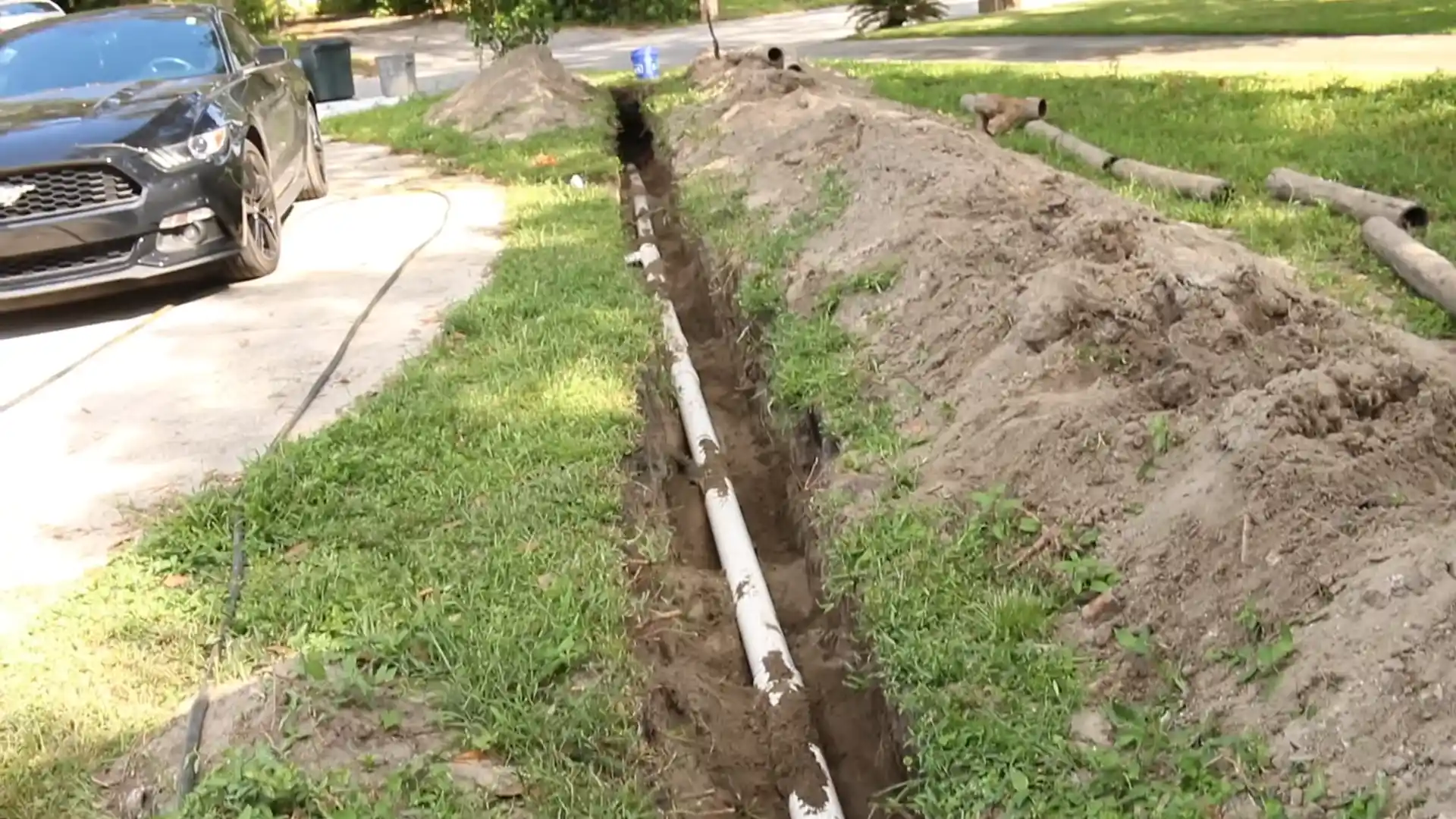
Lawns do not lie. Grass grows in proportion to what feeds it, and when one narrow band across a yard turns deeper green, grows faster, and shrugs off the dry weeks that brown everything around it, that band is being fed by something the rest of the lawn is not getting. Plumbing writers across the industry describe the same phenomenon in nearly the same words: leaking wastewater acts like fertilizer, and a lush stripe tracking a straight line through a yard is one of the most reliable exterior signs of a failing sewer lateral. The nitrogen your household sends down the drain every day is, in a broken pipe, being delivered directly to the roots above the break.
In Compton the odds behind that stripe are unusually well defined. The property owner here is responsible for the lateral from the house to the public main, and under the city's oldest neighborhoods those laterals are original equipment: vitrified clay and cast iron installed generations ago, materials now past every design life their makers imagined. Clay cracks at its joints and invites roots. Cast iron rusts from the bottom of the pipe upward. Either failure exfiltrates wastewater into the soil quietly for months, and the lawn is usually the first witness to talk.
The stripe's supporting witnesses
A green band alone earns attention. A green band with company earns a camera. The corroborating signs, drawn from the same casework the industry sources describe, stack like this:
| Sign | What it indicates | Urgency |
|---|---|---|
| Lush green stripe on the lateral's path | Nutrient-rich exfiltration feeding roots | Schedule inspection |
| Sewage odor outdoors, worse in heat or after rain | Sewer gas escaping a breach or bad cleanout cap | Schedule promptly |
| Soft, spongy, or soggy ground in dry weather | Soil saturated by escaping wastewater | Prompt; keep pets away |
| Sunken strip or shallow depression | Soil washing into or around the pipe, a void forming | Urgent; surface may settle further |
| Gurgling drains or backups indoors alongside any of the above | The line is failing hydraulically, not just leaking | Urgent |
Two innocent explanations deserve their fair hearing before anyone digs. A stripe can mark a buried irrigation line weeping fresh water, which fertilizes nothing but waters generously, and it can mark nothing more than a low seam where runoff collects. The nose usually separates them: fresh-water leaks do not smell, and the calendar helps too, since a stripe that thrives through a rainless Compton summer has excluded runoff by itself. When the smell is sharp and sulfurous, check the simplest suspect first, the outdoor cleanout cap, because a cracked or unseated cap vents sewer gas into a yard while the pipe itself is sound, and it is the cheapest fix in this entire subject.
Stripe, smell, or soft spot along the lateral path?A camera inspection dates the problem and prices the fix.
✆ (424) 544-0235What the camera settles
Everything above is inference. The inspection camera is evidence. A recorded run from the cleanout to the city connection shows the pipe's interior directly: the root mass at a clay joint, the rusted-through channel in cast iron, the offset where decades of soil movement pulled a connection apart, the belly holding water. Each defect gets logged by distance and located from the surface with a sonde, so the finding is not "your line is bad" but "a root intrusion at 43 feet, under the third stepping stone, two feet down." That precision is what turns repair from an excavation campaign into a surgical event, and the footage doubles as documentation for escrow, insurance, or a dispute over whether a defect sits on your side of the connection or the city's. The full protocol lives on our lateral inspection and repair page.
Repair without plowing the yard
The stripe's silver lining is that modern repair often spares the lawn that reported it. Laterals that have kept their shape qualify for lining or bursting through the pipe's own path, renewed from two small access pits while the grass, driveway, and roots above stay put. Fully collapsed sections still need conventional digging, and roots at a single joint often resolve with a spot repair rather than whole-line work. The camera decides among them honestly, which is precisely why it comes first: nobody should be quoted a trenchless lining, or a trench, before the footage says the pipe qualifies.
The Compton timing argument
Left alone, an exfiltrating lateral follows a known script. The escaping water keeps undermining soil until the stripe gains a depression, the depression gains a real void, and eventually either the surface drops or the pipe finishes collapsing and sends sewage up the lowest drain in the house, usually a shower, usually on a weekend. The senior blocks where original laterals concentrate, through North Compton and the city's pre-war core, write that script most often, and the households that interrupt it early spend a fraction of what the collapse edition costs. The lawn gave you the report for free. The camera converts it into a plan for a modest fee. The only expensive option on the table is filing the report away.
What to do this week
Walk the lateral's likely path, a roughly straight line from the house's main drain side to the street connection or cleanout, and mark anything the table above describes: tape at the stripe's edges, a photo of the soft spot, a note about when the smell is strongest. Check the cleanout cap for cracks and seating. Keep children and pets off any soggy area, since saturated soil over a sewer breach is unsanitary ground. Then book the camera with your observations in hand. A lateral that gets inspected while the grass is merely green stays a plumbing story. The ones that wait become landscaping, concrete, and biohazard stories, and nobody's lawn is worth that trilogy.
Sewer gas and health: the direct harm worth naming
The green stripe is the easy sign to discuss because it requires no alarm to explain. The odor side deserves a more direct sentence. Sewer gas is a mixture, and its constituents include hydrogen sulfide and methane. Outdoor exposure to the concentrations a cracked lateral typically produces is not the health emergency that indoor accumulation represents, but it is not harmless either, and the industry sources on this topic are consistent: persistent odor paired with any of the corroborating signs in the table above is a plumber call, not a wait-and-see. The "rotten egg" quality of hydrogen sulfide is the detection mechanism nature provided, and it works at concentrations well below hazardous levels, which means the nose is a safety instrument as much as an annoyance reporter. Households with young children or immunocompromised members should treat outdoor sewage odor as the prompt end of the triage checklist rather than the beginning, regardless of how mild the stripe or how dry the soft spot. The camera arrives in hours. The problem has been building for months. The math is not close.
Calling from Long Beach instead of Compton?
Everything above applies the same way north of the city line — the diagnostic steps, the pricing model, and the same dispatch. The one thing that can differ is water source: Long Beach blends imported and local groundwater through Long Beach Water Department rather than Compton's own well system, so mineral content can vary by block. See our Long Beach service area page for coverage details, or just call — the technician on your job will confirm specifics for your address either way.
Sewage actually backed up into the house, not just the yard?
A green stripe in the yard is one thing; sewage reaching a floor drain or fixture inside the house is a different level of cleanup entirely, with contamination and sanitation concerns a straightforward leak repair does not cover. water main break flooding and sewage cleanup specialists handle that side of the problem once the line itself is fixed.
Get the footage before the lateral picks its own weekend
One camera run answers everything this post raises, with recorded evidence you keep. Mark the stripe, note the smell, and call.
✆ Call (424) 544-0235