
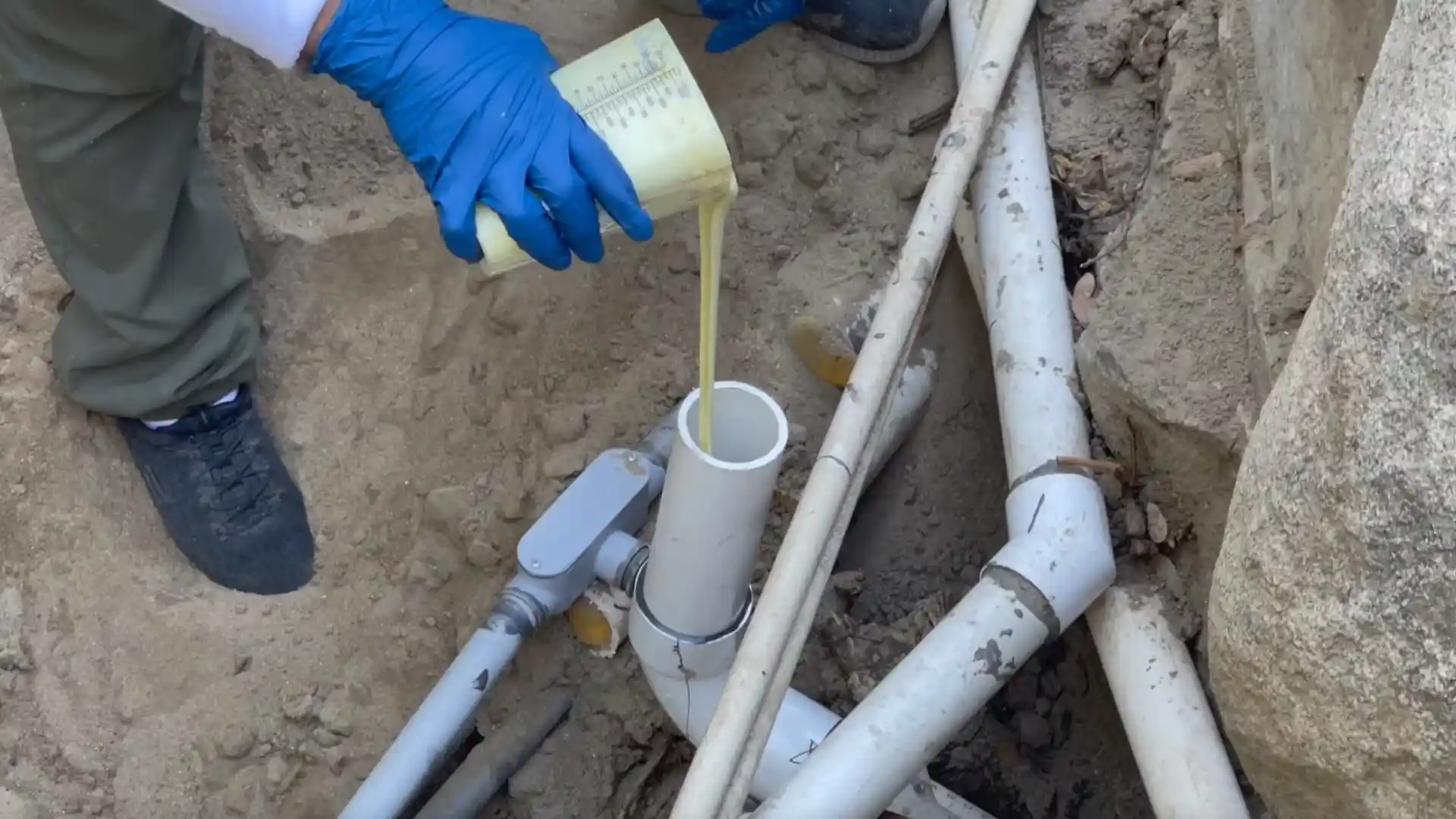
The old economics of a failed buried line were brutal: the pipe might cost hundreds, but the trench cost the yard. A sewer lateral replacement meant a backhoe scar from house to street, through lawn, sprinklers, a driveway cut, and whatever the decades had planted along the way, with the surface restoration line items often outrunning the actual plumbing work on the final invoice. Trenchless technology rewrote that bill. Assessment now happens from inside the pipe itself, by camera and sonde; renewal happens through the failed pipe's own existing path, by liner or by bursting, from access pits the size of a doormat at each end. The failure gets fixed. The surface, mostly, never learns about it.
Assessment first: the pipe testifies from within
Every trenchless decision starts with the camera, because the method's feasibility lives in the pipe's condition. The recorded run documents each defect with distance and clock position: root intrusions, cracks, offsets, bellies, the rusted-through channel of old cast iron. A sonde locates and depth-marks whatever matters from the surface. That footage decides everything after, whether the failing lateral holds enough shape to host a liner, whether a bursting head can follow the path, or whether honesty demands a conventional dig at one collapsed section. No trenchless quote worth signing precedes its video.
The two renewals: lining and bursting
Cured-in-place lining inverts or pulls a resin-saturated sleeve through the host pipe, then cures it into a new structural pipe within the old, jointless, root-proof, smoother than what it replaced, at the cost of a modest diameter reduction. Pipe bursting pulls a splitting head through the old line, fracturing it outward while towing a new pipe into the void, full diameter or larger, and indifferent to how bad the host had become as long as the path holds. Lining favors pipes that kept their shape; bursting favors the truly finished ones. Supply-side equivalents pull new service line through the old alignment the same way, entry pit to exit pit, driveway untouched.
What qualifies, and what does not
Trenchless is a candidate assessment, not a universal answer, and the disqualifiers are worth knowing. Fully collapsed sections leave nothing to follow; severe bellies survive lining as low spots unless corrected; some tie-in geometries and proximity to other utilities complicate bursting. Depth, soil, and access set the pit locations, and this coastal plain cooperates on all three more often than not, soft easy digging for the access pits, laterals sitting at reachable depth, and lots that offer workable equipment access. Compton's pre-war lateral stock, clay and cast iron under its oldest blocks, is exactly the cohort the technology was built to renew, and the same vintage runs through neighboring Carson on our routes.
The restoration you never pay for
The quiet argument for trenchless is everything that does not happen afterward: no re-sodding a trench line, no driveway pour, no season waiting for the yard to forgive you, no gamble on matching thirty-year-old concrete. Two small pits close in an afternoon. For lines under prized hardscape, mature trees, or simply a lawn someone worked for, the method usually wins the total-cost argument even when its line-item price runs higher. To find out whether your line qualifies, start with the camera: (424) 544-0235.
Timing tilts the economics too. A lateral renewed on schedule, after the camera flags decline but before collapse, keeps every trenchless option open and prices the work as a plan instead of an emergency. The same pipe six months past collapse forfeits lining, complicates bursting, and usually meets a backhoe anyway. The camera footage is cheap, the calendar is patient, and collapse is neither. Waiting is the one option that closes doors.
Buried line failing under hardscape you want to keep?Dispatch answers 24/7. Written quote before any work.
✆ (424) 544-0235Trenchless questions from Compton properties
How long does a trenchless lateral renewal take?
Most residential linings and bursts complete in a day, camera to reconnection, with service interruption measured in hours. The access pits close the same day and the surface work is patching, not restoration.
Does a liner reduce my pipe's capacity?
It narrows the diameter slightly and improves the flow anyway, because the cured liner is smoother and jointless where the old pipe was rough and root-snagged. Properly sized, capacity concerns are rare in residential laterals.
Can trenchless fix a line under my driveway or pool deck?
That is its signature case. The renewal follows the existing path beneath the hardscape between two pits placed clear of it, and the concrete never learns the pipe changed.
Is trenchless repair permitted and inspected like open-trench work?
Yes. Lateral renewals here run through the same permit and inspection process, and the camera footage before and after gives the inspector, and you, better documentation than most open trenches ever get.