
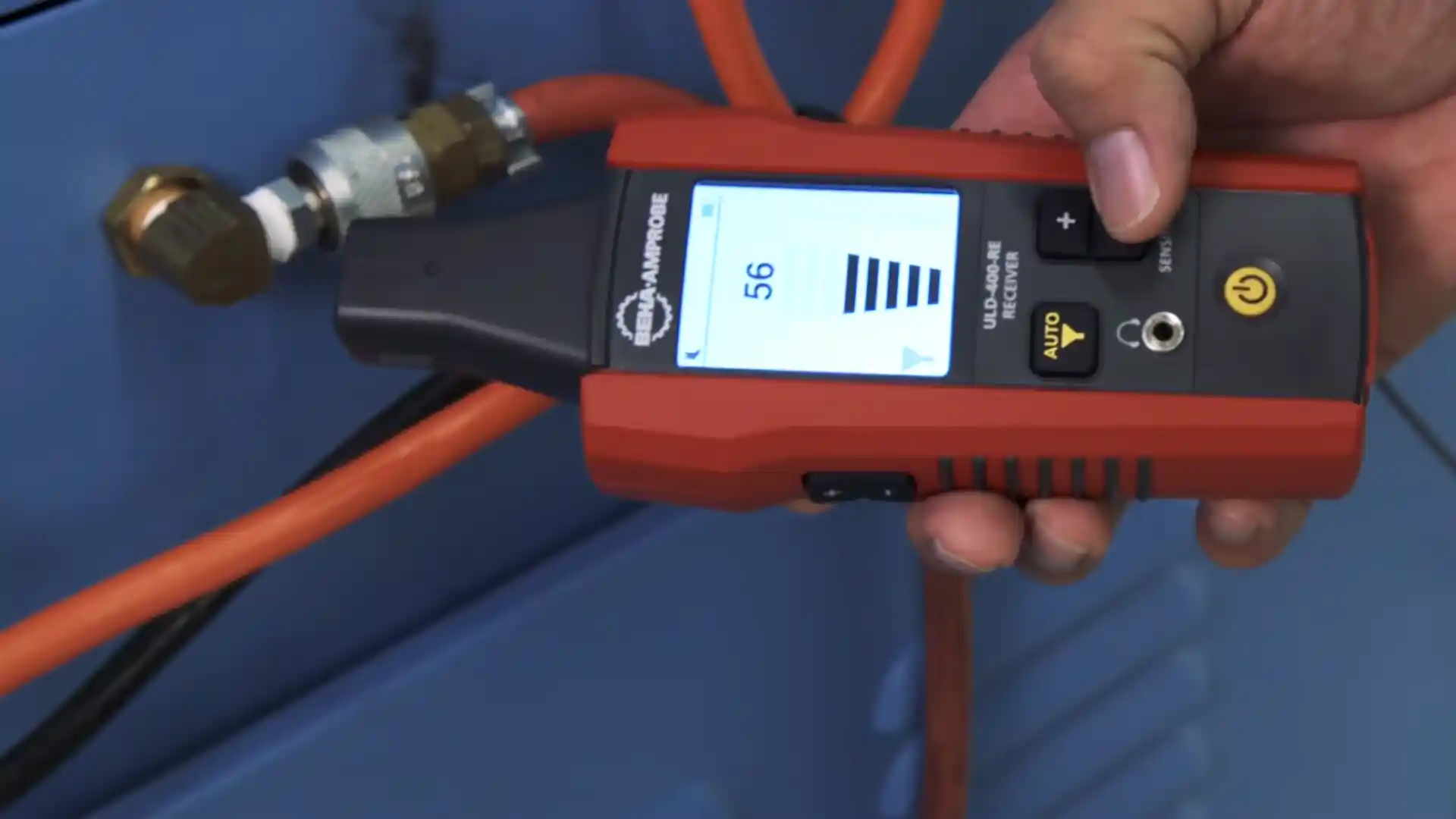
Squeeze a leak small enough and its voice climbs out of human range. A fine orifice under pressure emits most of its energy as ultrasound, vibrations from twenty kilohertz on up, pitched above any ear and above most of the ambient racket that plagues audible-band listening. Ultrasonic detection lives in that high, quiet country: sensors tuned to the 35 to 45 kilohertz window where turbulent escape concentrates, electronics that heterodyne the signal, shifting it down into headphones as an audible hiss a technician can chase. The method trades the long reach of low frequencies for something often more valuable: selectivity, because almost nothing else in a building speaks that language.
Where high frequency earns its keep
Ultrasound attenuates fast in soil and concrete, so this is not the tool for deep burial. Its territory is line-of-sight and close contact: fittings, valves, fixtures, exposed runs, mechanical spaces. A passing valve, one that reads closed but bleeds water through a worn seat, is nearly silent audibly yet lights up an ultrasonic sensor at the body. Fine fitting leaks in commercial mechanical rooms get swept in minutes, sensor tracing manifolds and unions like a stethoscope down a line of patients. And equipment-dense installations, none denser than a spa's packed cabinet, suit the probe's ability to isolate one hissing union among thirty quiet ones inches apart.
Directionality: the second advantage
High frequencies travel in straighter lines and shadow behind obstacles, which sounds like a weakness and works like a feature. An ultrasonic sensor is directional; sweep it and the signal peaks when the probe points at the source, falling off sharply to either side. That lets a technician triangulate a leak in a crowded space, distinguish the guilty fitting from its neighbor four inches away, and confirm a suspect by simply shading it, blocking the path with a hand and watching the signal drop. Audible-band gear, hearing everything from everywhere at once, cannot offer that kind of pointing finger.
Compressed air, gas lines, and the crossover cases
The same physics covers more than water. Compressed air systems in the shops and light industry along the Long Beach Boulevard corridor bleed money through fine leaks that ultrasound finds in a single walk-through. Vacuum lines, pneumatic controls, and the nitrogen side of a tracer-gas locate all speak ultrasonic. On the water side, the crossover rule is pressure and proximity: the finer and closer the suspected failure, the better this method fits, and the deeper or larger it runs, the sooner we hand the case to ground microphones, correlation, or gas.
A quiet method for early problems
Because ultrasound favors the small, it is the natural instrument of early detection, catching the weep that precedes the burst, the passing valve before the bill notices, the fitting that will flood a cabinet next year. That makes it a fixture of our commercial surveys and a regular closer on residential cases where everything obvious has been ruled out and something fine is still escaping. To put the high-frequency ear on your system, dial a number pitched well within human range: (424) 544-0235.
Reading the readings
Like every instrument on the truck, the ultrasonic gun reports numbers a technician has to interpret. Decibel levels in the ultrasonic band scale with orifice size and pressure, so a reading at a fitting gets compared against line pressure and its neighbors, not judged in isolation. Competing sources exist even up here, some electronics and certain lighting whine ultrasonically, and the directional sweep is how we separate a genuine escape from ambient chatter. The findings sheet records the peak readings by location so the evidence outlives the visit.
Suspect a fine leak or a valve passing water silently?Dispatch answers 24/7. Written quote before any work.
✆ (424) 544-0235Ultrasonic detection questions from Compton
What is the difference between ultrasonic and acoustic detection?
Frequency band and territory. Acoustic ground work listens in and near the audible range, where signals travel far through soil and slab; ultrasonic listens above hearing, where fine close-range leaks and passing valves stand out. They complement rather than compete.
Can ultrasound find a leak under my slab?
Rarely on its own; concrete and soil absorb high frequencies quickly. Under-slab cases belong to ground microphones, correlation, thermal, and gas. Ultrasound joins where lines surface: manifolds, valves, and fixtures.
What does a passing valve mean and why does it matter?
A valve that no longer seals fully even when closed. It wastes water or heat continuously, mimics mystery leaks, and defeats isolation testing. Ultrasonic scanning at the valve body catches it in seconds.
Is the ultrasound harmful to people or pets?
No. The instrument mostly receives sound the leak already makes; even active ultrasonic sources used in some tests operate at low, localized levels. Dogs may notice a test tone; nothing is hazardous.