
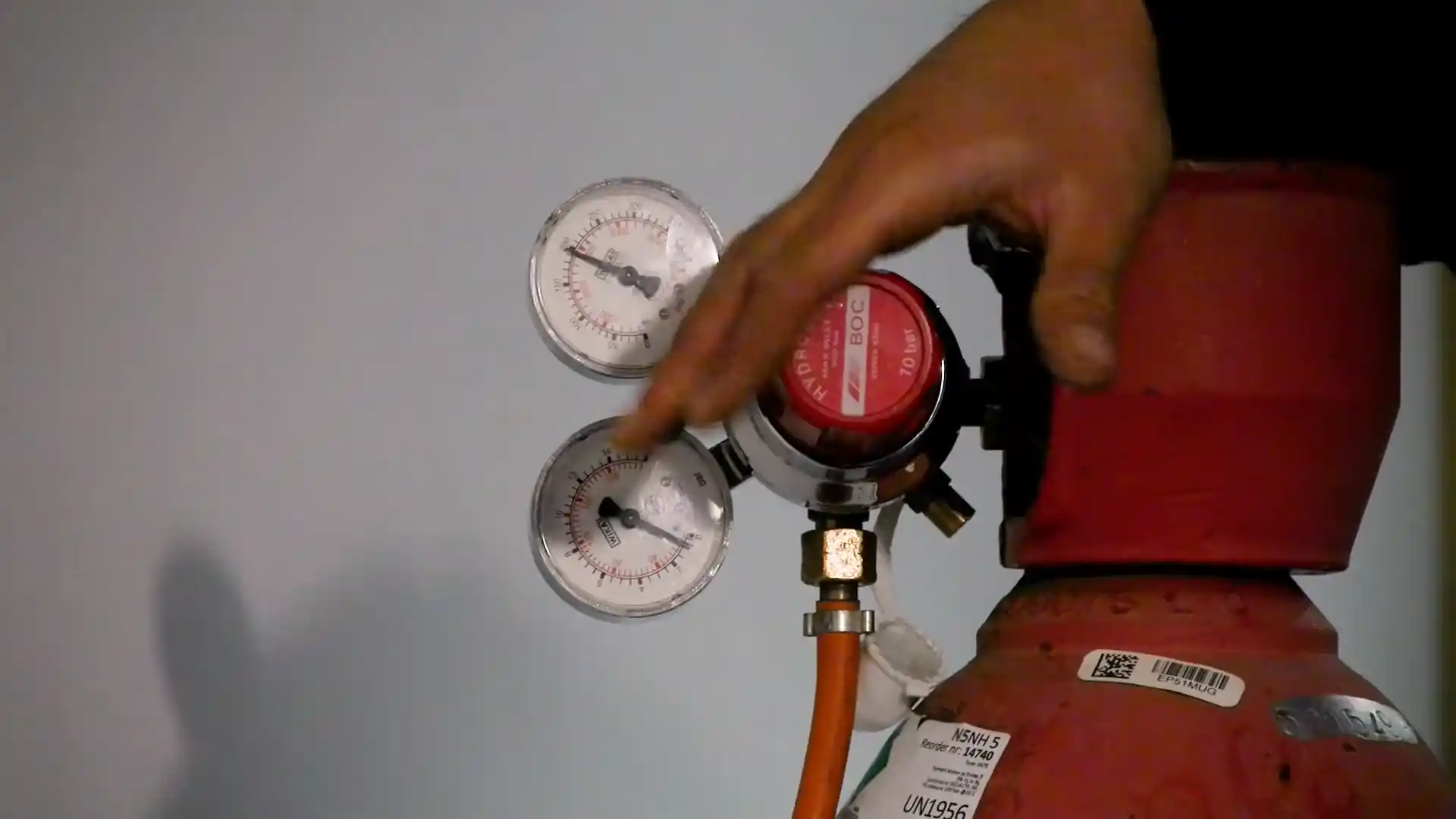
Some leaks simply do not sing. A weep too fine to generate turbulence, a breach below the water table gurgling into saturation, a failure in plastic pipe that carries no ring, a drip so slow the ground swallows its evidence: acoustic methods need a signal, and these produce almost none. Tracer gas detection sidesteps the whole problem by changing what escapes. We empty the suspect line of water and charge it with a tracing mixture, 95 percent nitrogen carrying 5 percent hydrogen, and let the breach do the only thing it can: leak. The gas exits the pipe at exactly the breach the water used, and hydrogen, the smallest and lightest molecule there is, climbs through soil, gravel, concrete, and tile to the surface, where a sniffer probe reads its arrival in parts per million.
Why hydrogen, and why it is safe
The tracer works because of what hydrogen is. Smaller than any other molecule, it penetrates paths water itself squeezed through; lighter than air by an order of magnitude, it rises nearly straight, so the strongest surface reading sits close above the breach rather than drifting downslope. The 5 percent blend matters for safety: diluted in nitrogen at that ratio the mixture is non-flammable by classification, inert in the line, and harmless to pipe, seals, and the potable system, venting to nothing but air when the test ends. It is the same formulation industry uses to test everything from refrigeration to gas mains, scaled to a house call.
The protocol, from purge to paint
A gas locate is methodical by design. The target line is isolated and drained, because standing water blocks gas from reaching the breach. The charge goes in at controlled pressure. Then the survey: probe readings on a tight grid across the surface along the line's mapped route, concentrations logged, the gradient followed uphill to its peak. Concrete gets drilled with small vent holes only where slab cover would otherwise trap the gas sideways. The peak gets marked, the concentration curve documented, and the line vented and returned to service. On landscape locates the probe reads right through turf; on hard-scaped lots the vent-hole pattern does the work.
The cases gas was made for
Our gas rig earns its space on a short list of stubborn categories. Fine copper failures misting silently into a slab's underside. Plastic irrigation and service lines whose material kills every acoustic approach. Leaks under Compton's wet-season water table, common on the low ground toward the Willowbrook border, where saturation drowns sound but cannot stop a rising molecule. Long rural-scale runs where a grid of readings beats a mile of listening. And re-locates, the jobs where a previous mark missed, because gas evidence is independent of everything the first attempt relied on.
Certainty, priced honestly
Tracer gas costs more than a listening pass: the equipment, the purge time, the grid discipline. We reach for it when its certainty is cheaper than the alternative, a second wrong hole in a slab, an exploratory trench through finished landscape, another month of a silent leak on the bill. The findings sheet shows the readings so you can see the evidence gradient yourself before anyone cuts anything. When a leak has gone quiet on everyone, (424) 544-0235 brings the molecule that cannot keep a secret.
Scheduling note worth knowing: gas locates run best with the target line out of service for the duration, typically a few hours. We coordinate the purge window and the survey grid around your household's actual water needs for the day, and most homes keep every other fixture running normally throughout the test.
Silent leak that has already beaten a listening survey?Dispatch answers 24/7. Written quote before any work.
✆ (424) 544-0235Tracer gas questions from Compton locates
Is the gas safe for my drinking water pipes?
Yes. The nitrogen-hydrogen blend is inert, food-industry familiar, and vents completely when the test ends. Lines return to service immediately after a flush, with nothing left behind but the locate mark.
How accurate is a tracer gas locate?
On open ground, typically within a foot of the breach, since hydrogen rises nearly vertically. Slab cover widens it slightly and vent holes tighten it back. The logged concentration gradient shows exactly how sharp the peak was.
Why does the line have to be drained first?
Because gas must reach the breach to escape through it, and water in the line blocks the path. The purge is the least glamorous and most important step in the whole protocol.
My leak was already located once and the dig missed. Can gas re-check it?
That is one of its best uses. Gas evidence is independent of sound, heat, and the first locate's assumptions, so it either confirms the original mark or moves it, with readings to justify whichever it does.