
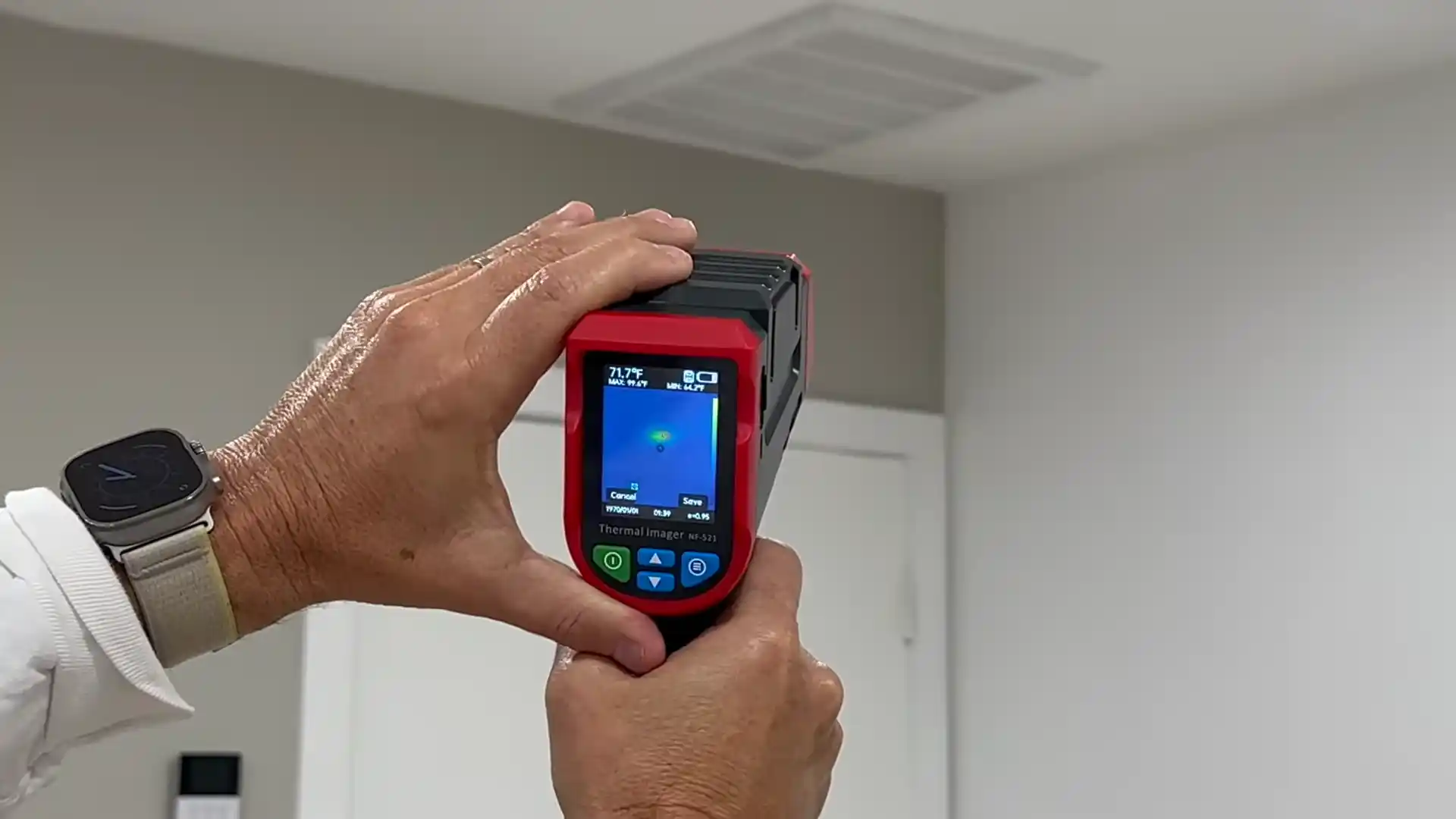
Point an infrared camera at a wall and you are not seeing through it. You are reading its skin, tens of thousands of surface temperature measurements rendered as a picture, sensitive to differences smaller than a tenth of a degree. Leaks betray themselves on that skin in two opposite directions. A hot supply line leaking under a slab warms the concrete above it into a glowing plume with the failure near its brightest heart. And moisture anywhere, from any source, cools the surface it soaks, because evaporation steals heat; wet drywall reads as a cold shadow against its dry neighbors. One instrument, two signatures, and neither requires touching the surface at all.
Where the camera leads the whole case
Thermal work opens most of our indoor investigations because it maps before it accuses. A stained ceiling gets scanned and the cold moisture footprint appears in full, its shape pointing upstream toward the source in exactly the way a ceiling case demands. A suspected hot-side failure under floors gets the plume treatment, and in Compton's slab-on-grade majority that image regularly turns an under-concrete locate from a survey into a confirmation. Wet walls, sweating ducts, shower surrounds, radiant lines: anywhere temperature and moisture intersect inside a building, the camera drafts the working map that the contact instruments then verify point by point.
Reading infrared honestly
The discipline is in the interpretation, because the camera reports temperature, not water. A cold spot can be a draft, missing insulation, or a metal stud line; a warm patch can be sun-load through a window an hour ago or wiring working behind the drywall. False positives embarrass amateurs and cost owners money, so every thermal anomaly we flag gets a second, independent test: a moisture meter on the cold shadow, a pressure isolation behind the warm plume. Materials complicate matters too, since shiny surfaces reflect the room's heat rather than reporting their own. The camera proposes. Instruments and physics dispose.
Working the local conditions
Compton's climate and construction shape the technique. Mild coastal air means indoor-outdoor temperature contrast is often small, so we manufacture contrast instead of waiting for it: running hot lines deliberately to charge a plume, or scanning early morning when slabs still hold the night's cool. Postwar tract construction through West Compton and its siblings puts hot runs in predictable slab routes, which lets a scan concentrate where the era says pipe should be. And the city's very hard well water plays its part, since scaled hot lines run hotter to deliver the same tap temperature, sharpening the very plumes we hunt.
The picture you keep
Every thermal case ends with the images themselves: the plume, the moisture shadow, the before and after of a repair verified dry. Owners get them, insurers respect them, and repairs that closed over a verified-dry cavity carry proof it was so. A camera pass adds minutes to a diagnosis and subtracts guesswork from everything after it. To see what your walls and floors are hiding, in the most literal sense available, call (424) 544-0235.
Beyond leaks: what else the lens catches
Because the camera reads the whole surface at once, thermal passes routinely surface findings beyond the leak that booked them: insulation gaps bleeding heat along a wall, ductwork sweating in a chase, the warm trace of an overloaded circuit worth an electrician's look. We flag what we see and stay in our lane on the fixes. Owners tend to value that incidental map almost as much as the locate itself, since no other ten minutes of any service call photographs a building's hidden thermal behavior quite so completely, room by room.
Want the wet path mapped before a single opening is cut?Dispatch answers 24/7. Written quote before any work.
✆ (424) 544-0235Thermal imaging questions from Compton
Can the camera see pipes inside my walls?
Not directly; it reads surface temperature only. Pipes appear when they change that surface, a hot run warming drywall, a leak's moisture cooling it. That indirectness is why every find gets confirmed with a second method.
Does thermal imaging find cold water leaks?
Yes, through the moisture signature rather than a heat plume: evaporating water cools the wet surface below its surroundings. The contrast is subtler than a hot-line plume, so meters and timing matter more on cold-side cases.
Is there any radiation or safety concern with the scan?
None. The camera is entirely passive, receiving infrared the surfaces already emit, the same energy a hand feels near a warm wall. Nothing is transmitted into the home.
Why scan in the early morning?
Contrast. Slabs and walls hold the night's coolness, so a hot line's plume stands out sharply before the day flattens the differences. In this mild climate, timing the scan is often the difference between a crisp image and a vague one.